

Large-scale solar land — the United Kingdom, Ireland and Europe
Turn suitable land into long-term solar income.
LandBank Intelligence identifies and assesses agricultural land before we make contact, so every conversation starts with a reason.
If we’ve contacted you, your land has already stood out.
Free initial assessment · No obligation

Why have we contacted you?
Because your land
stood out.
Before making contact, LandBank Intelligence has already screened the opportunity against the factors that determine whether solar is worth investigating.
In plain terms, the screen asks six questions:
Enough land
Is there enough usable acreage to make a project worth exploring?
Solar potential
Does the location have the characteristics needed to generate effectively?
The ground
Are slope, terrain and flood risk workable?
Land quality
Could the right parcel be used without unnecessarily taking the best agricultural ground?
Planning
Are there obvious environmental or planning constraints?
The grid
Is there electricity infrastructure nearby that makes further investigation worthwhile? Nearby infrastructure does not confirm capacity.
Every opportunity is screened and scored before contact. Only those showing sufficient initial potential progress to outreach.
These are initial origination screens. They are not a formal grid offer, planning permission, a survey, legal or title due diligence, or engineering design. All of that comes later, through the downstream project company.
Passing this screen doesn’t mean a solar project is guaranteed. It means we’ve found enough evidence to believe a proper conversation is worthwhile.
Give the land another job
Some acres earn their keep.
Some barely do.
Every farm has ground that earns its place — and ground that works much harder for much less. The awkward field, headland or corner can take the same diesel, seed, labour and time, yet in a difficult year barely break even. That is the acreage worth a second look.
01
A second use for the weakest ground
Suitable underperforming acreage can become a productive long-term asset, measured in decades rather than seasons, instead of being worked hard merely to break even.
02
No upfront construction capital from the farm
Under the current funded partner model, the solar construction cost is not met from existing farm cash.
03
The right parcel, not the whole holding
We look at a defined, genuinely available parcel. The rest of the farm carries on, subject to eventual access, cabling and project design.
04
Evidence before commitment
If the evidence does not stack up, we say so. There is no obligation to proceed.
An income stream that does not depend on the harvest: this is grid-export solar for income, not panels to power the farmyard.
Worked project example
What could 5 acres look like?
One surveyed site near Leamington Spa, modelled on its own figures.
The site and the system
- Land area
- 5 acres2.02 hectares
- Indicative system size
- 941.6 kWp
- Estimated clean generation
- 763.2 MWhper year — approximately 763,172 kWh
- Yield basis
- 811 kWh/kWpshading-adjusted
- Modules modelled
- 2,116445W panels
- CO₂ avoided
- 132,563 kgper year
The modelled commercial picture
- Modelled annual export income
- £115,239per year — project export income in the partner model
- Modelled 25-year net export value
- £2,973,797project-level modelled value across the modelled term
- Indicative capital cost
- £753,296excluding VAT — supplied by the delivery partner
- Indexation assumption
- 2.99%per annum, as supplied in the partner model
These are project-level modelled figures for one surveyed site. Project export income and modelled project value are not automatically the same as landowner income, which depends on the finance structure and the eventual agreements.
Figures supplied from a worked delivery-partner project model for this surveyed site. They are illustrative of that project only and are not a quotation, forecast or guarantee for other land. Actual generation, export arrangements, finance, costs and returns are site- and contract-specific.
Could your land support something similar?
Every parcel is different. Give us the location and we will model yours on its own evidence.
The partner-funded model
Choose income sooner, or clear the finance sooner.
LandBank identifies and qualifies land and introduces it to the parties who deliver. We do not install, construct or finance. What follows is the current delivery partner’s model, not a description of every solar finance product.
Export revenue from the commissioned asset services the finance. Under the current partner model, how that revenue is prioritised is a matter of the terms agreed.
Typical partner-model finance period: 3–5 years**Supplied delivery-partner guidance indicates repayment is commonly modelled over approximately three to five years, depending on project-specific factors and how much export revenue is directed towards repayment. Final finance terms are subject to underwriting and agreement.
Option 01
Clear the finance sooner
Direct up to 100% of the available project export revenue towards repayment, reducing the finance as quickly as the agreed structure allows. Once it is repaid, project income is no longer servicing that finance and can continue over the remaining operating life, subject to the agreements and to how the array performs.
Option 02
Take income from the outset
Alternatively, under the current partner model a proportion of export income — potentially up to 50% — may be taken by the landowner from the outset of the project's operating period, with the balance servicing the finance. Repayment then takes longer. Subject to underwriting, final terms and actual export performance.
The principle is simple: prioritise earlier income, faster repayment, or a balance between the two.
- Funded solar asset
- Electricity generated
- Export revenue
- Choose repayment / income balance
- Finance cleared
- Continuing project income
- Under this model the landowner owns the solar asset and is the finance counterparty, so the funder assesses the landowner; a trading farm or business behind the application is a material advantage.
- No upfront solar construction capital is taken from existing farm cash.
- Exact terms are contractual and project-specific. Take your own legal, tax and financial advice before signing.
Land criteria
What makes a strong solar land opportunity?
Not every field should become a solar project. This is the filter, set out plainly, so you can form your own view before we speak.
Around five usable acres or more
Genuinely available acreage, not a nominal figure. Below roughly five acres, large-scale export solar rarely suits.
Checkpoint 1Level or gently sloping ground
A sensible field shape and workable access. Steep or broken terrain adds cost the scheme cannot always carry.
Checkpoint 2Constraints that can be managed
Floodplain land is a material constraint and usually rules a site out. Designations and land classification are screened early.
Checkpoint 3Useful access to three-phase grid infrastructure
Three-phase infrastructure on or close to the holding can materially strengthen an opportunity, particularly where extensive cabling is not required. Capacity and connection feasibility still have to be established for the individual project.
Checkpoint 4A route to the network that makes sense
The distance and the scheme size have to work together. We judge the grid evidence site by site rather than by a blanket distance rule.
Checkpoint 5A landowner or farm business able to satisfy a financier
Financial standing forms part of qualification, because the landowner is the finance counterparty under the current partner model.
Checkpoint 6Clear authority to explore it
Someone with genuine authority over the land, and a real openness to a long-term use of it.
Checkpoint 7
If your land does not work, we will tell you quickly and plainly, and that will be the end of it.
Don’t know whether your land qualifies? That is exactly what the initial LandBank screen is for.
Indicative solar scale
Roughly what scale of solar could fit?
Enter the acreage you think might be available for an indicative technical capacity range. These are national rules of thumb for layout density only. A real LandBank assessment uses site-specific evidence rather than averages, and is an origination illustration rather than any form of quote.
Whole or decimal acreages are fine. A rough figure is enough at this stage.
Indicative capacity range
—
- Conservative — 4 acres per MW
- —
- Base — 3 acres per MW
- —
- High density — 2 acres per MW
- —
Site shape, grid, terrain and planning determine what is genuinely viable. These figures are indicative technical estimates based on typical layout density only.
Capacity is only half the picture.
What a site can generate depends on things a web page cannot know: the yield your own land records rather than a national average, where the nearest viable grid connection sits, and the shape and gradient of the fields.
Tell us where the land is and we will model yours on its own figures.
How it works
Four steps, in order.
LandBank handles the first three. The fourth belongs to the funded project company.
01
Conversation
LandBank
A short call. We explain why the land may warrant a look, and you tell us whether a long-term solar use is something you would ever consider.
02
Evidence-led screen
LandBank
We go through the evidence with you: the parcel and its access, how it is used now, the available acreage, solar yield modelled for the site, flood, terrain, land classification, constraints and grid evidence.
03
Qualification and matching
LandBank
If there is genuine interest and the site still looks viable, we confirm the land situation and who can make decisions, then match the opportunity to a funded project company suited to that scale and location.
04
Downstream development handover
Project company
The project company takes it forward: formal grid application, surveys and design, planning due diligence, legal and title work, contracting and delivery, alongside your own advisers.
A second route for landowners
Considering selling land?
Alongside long-term solar opportunities, LandBank now reviews farms, estates, agricultural and strategically located land for outright acquisition across the UK and Ireland.
Why LandBank
Built on data. Backed by experience.
LandBank Intelligence is a purpose-built land-origination platform, engineered to identify and prioritise solar opportunities before a conversation begins. It combines a growing evidence base with decades of energy and renewables experience across our delivery network — turning raw land data into a shortlist worth investigating.
- 6,425
- current opportunities
- 25,984
- site-assessment records
- 6,425
- grid-evidence records
This is not mass prospecting. It is evidence-led origination.
Straight answers
Common questions.
- Do solar panels work when it is cloudy?
- Yes. Panels generate from daylight, so they carry on working on overcast days. Output is lower than in strong, direct sunshine and varies with the season, which is why yield is modelled for each specific site rather than taken from a national average.
- How much land do I need?
- Around five acres of genuinely available land is the practical starting point. Larger parcels open up more options, but viability depends on the site rather than acreage alone.
- Will you use my whole farm?
- No. We look at the acreage that is potentially suitable and available. The focus is a defined parcel; access, cabling and any other requirements are dealt with through the final project design and agreement.
- Can sheep still graze around solar panels?
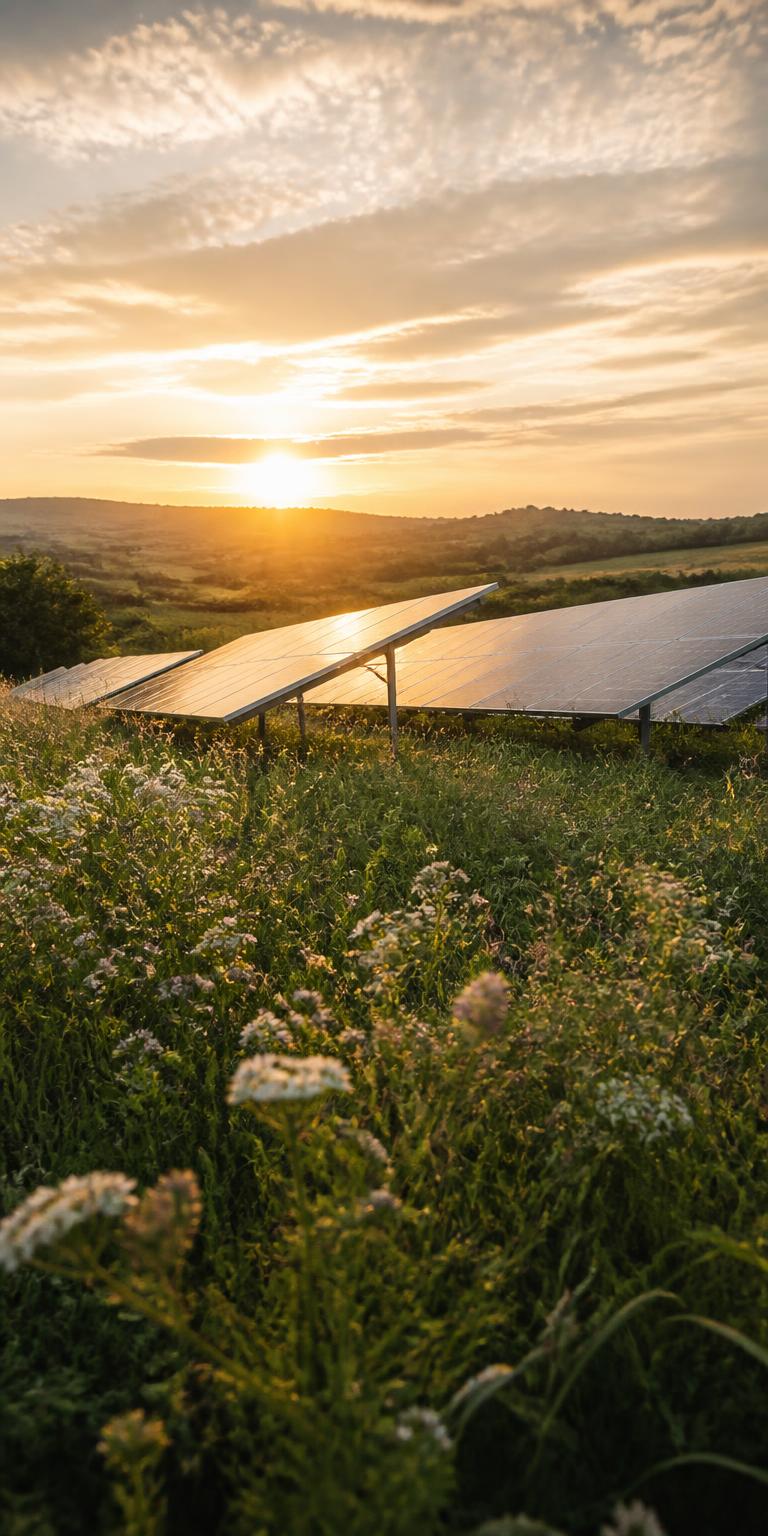
- Compatible agricultural use such as sheep grazing is often possible within a solar site, subject to the final project design and operating arrangements.
- Is there any benefit to wildlife?
- Well-designed projects can create biodiversity and habitat opportunities alongside generation, subject to project-specific design and planning conditions.
- Does this mean taking prime farmland out of production?
- Not as a blanket approach. Agricultural Land Classification is screened at the origination stage. In England, national policy encourages lower-quality agricultural land to be preferred where agricultural land is needed for solar. Planning policy is applied separately in England and Wales, and site-specific judgement sits downstream.
- What happens to the land at the end of the project?
- Decommissioning and restoration obligations are dealt with in the eventual project agreement. They are matters to review with the project company and your own professional advisers.
- Does a good initial assessment guarantee a project?
- No. Our screening is an origination step. Formal grid application, planning, surveys and design, legal and title work and downstream due diligence all still follow, and a good number of sites are ruled out along the way.
- What happens after LandBank?
- If a site qualifies and you want to proceed, we hand the opportunity to a funded project company. They take on the development and delivery, working with you and your own advisers.
- Where do you work?
- LandBank originates land across the United Kingdom, Ireland and Europe. Our delivery partners and funders operate across those same territories, including current partner-led project activity in Poland.
Enquire
Let’s see whether the land stacks up.
Give us the postcode and approximate acreage. That is enough for an initial look. If the site is worth taking further, we’ll tell you. If it isn’t, we’ll tell you that too.
Sam Tuppen
Land origination & qualification
If you would rather talk it through first, call.